Notice: Function _load_textdomain_just_in_time was called incorrectly. Translation loading for the all-in-one-seo-pack domain was triggered too early. This is usually an indicator for some code in the plugin or theme running too early. Translations should be loaded at the init action or later. Please see Debugging in WordPress for more information. (This message was added in version 6.7.0.) in /home/ue3sz8xj/public_html/wp-includes/functions.php on line 6170 Value | Digi Life Enabled - Part 2
How you invest your time determines how your financial future will unfold
Many say they cannot invest because they have no money. The wise invest their time when they have no money.
Unfortunately, many people have no time to invest. Why? All their time is spent in their place of work because they think that working harder and longer will make them financially richer. Nothing could be further from the truth. Working more doesn’t mean making more.
If you ask most people why they’re doing all this work, they’ll tell you it’s for money. By this, they mean a steady paycheck that provides security.
Money is one of the primary reasons people take on a high-paying job that they don’t like but which they spend most of their waking hours at — all while the things they really love in life sit on the sidelines waiting for them to finish working.
The problem with this approach is that you only make money as long as you show up at your place of work. The only thing of value that you have to sell to an employer is your time. So, in order to make more money, you have to work longer hours, which is physically exhausting.
Because you only have a finite amount of time and energy, as an employee, your earning potential is finite.
You only have so many days you can sell.
Conversely, if you ask most wise people what they work for, and they’ll tell you it’s for assets.
By this they mean investments and businesses that provide steady cash flow each month with little-to-no work. Instead of spending their life working for money, the wise work to understand how to make money work for them through financial education.
Adding more assets is much different than working for a paycheck. For instance, adding assets doesn’t require working longer or harder. These assets provide passive income, even while you’re sleeping or playing.
This is not to say that the wise don’t work. They do, they just work for different outcomes.
Seeing the massive opportunity the online world offered in the form of digital assets, but growing up in the pre-internet age and not being confident in digital skills, we invested time to grow our online business (digital assets) through financial education when we had no money to speak of, and found the education and mentoring given by SFM of real clarity amongst all the noise. That’s why we choose to signpost others to their services.
How about you?
What are you working for?
What are you investing your time in?
Are you working towards making money work for you through the power of assets?
Or do you spend your days toiling away at a job you hate in order to make money?
If so, what’s holding you back?
We encourage you to put some time aside to start investing in your financial education and building for your future through the power of assets.
If you haven’t done so already, why not try the Webcast which is transforming perspectives on how to generate an income online, revealing strategies for growing your income with a business you are passionate about. Click here to get started.
Global action is required to tackle the web’s “downward plunge to a dysfunctional future”, its creator Sir Tim Berners-Lee has told the BBC this week.
He made the comments in an exclusive interview to mark 30 years since he submitted his proposal for the web.
Clearly Sir Tim created the web with his own design intent for good, so it must grieve him deeply on a personal level to see that which he created for good, be abused.
In fact, it was our own aversion and concern over the ‘dark/bad’ side of the web that made us stay clear of it for so long.
We had looked at options for starting an online business from home because of the time and financial freedom the online business model offered, in particular it would lend itself to some of our overseas charity work, enabling us to generate an income 24/7 from anywhere in the world as long as we had a laptop and wifi (the good side to the web).
But, we were very skeptical about online scams, and so didn’t know who we could really trust to start off with in a virtual world.
At the same time we realised we were actually already living in our own ‘scam’ if we thought by carrying on in the same traditional economic system things would somehow magically change by themselves for the better.
So, we realised we had to take responsibility and action to leverage the many benefits the web offered, rather than just focus on the negative aspects, and we’re so glad we did.
In our world where we live, there is use and abuse of everything that was intended to be provided for our good. There’s nothing necessarily inherently wrong in anything, it’s whether we chose to use that ‘thing’ that ‘tool’ that ‘provision’ for good or for evil, that’s what really matters.
So, is the web a force for evil or good?
That really depends on each of us and our free choice.
Most people in developed countries admit to using a technological device during the hour before turning in, and children often use electronic media to help them relax at night.
Now, if you’re getting started in setting up an online business, or are already running one, then you may be one of those statistics who use electronic devices late into the night, like we used to, until we found out the evidence that this can make it harder to settle down to sleep.
You see, using electronic devices before bedtime can be physiologically and psychologically stimulating in ways that can adversely affect your sleep.
Here’s what happens: Using TVs, tablets, smartphones, laptops, or other electronic devices before bed delays your body’s internal clock (your circadian rhythm), suppresses the release of the sleep-inducing hormone melatonin, and makes it more difficult to fall asleep.
This is largely due to the short-wavelength, artificial blue light that’s emitted by these devices, LED light in particular. The more electronic devices that a person uses in the evening, the harder it is to fall asleep or stay asleep, even if you’re physically exhausted, because of how the messaging in the brain responds to that type of light.
Besides increasing your alertness (like caffeine) at a time when you should be getting sleepy, which in turn delays your bedtime, using these devices before turning in not only delays the onset of REM sleep – the most productive part of sleep, but reduces the total amount of REM sleep too, thereby compromising your alertness the next morning. Over time, these effects can add up to a significant, chronic deficiency in sleep. Which is bad news not only for running a business, but bad news for your health and well being.
All of this is true for children and adults alike.
Research shows the onset of sleep can be delayed by the use of electronic viewing devices at night
Sunday is a great time to pause from our work and enjoy REST with those dear to us. So this Sunday, why not try to cut out electronic devices and even dim the lights (especially LED lights) for the night. Try stopping ‘screen time’ two hours before bed, one hour before bed, or even 30 minutes before bed—the earlier in the evening, the better, but whatever is realistic in your circumstances.
We implemented this change and really felt the benefit.
One good substitution is reading an old-fashioned printed book under lamplight (as opposed to bright overhead lighting) or an e-reader (like the Kindle Paperwhite, as opposed to the Kindle Fire) is also a good idea, because it doesn’t produce the same type of blue light that a smartphone or tablet would.
Anyway try these tips for yourself, and let us know if your sleep improves.
Hope you have a restful Sunday with those dear to you!
None of us want to be guilty of being unproductive, whether that’s in our work performance, sporting performance, financial performance, I mean, life’s too short to waste it, so any reasonable person wants to use their time in a productive manner.
In fact our western society is set up to increase productivity in every area of life, so no matter where you look we’re encouraged to do more and get more.
In my late teens and early twenties, like most guys, improving my physical athletic performance was high on my list of priorities. “No pain no gain” was the given mantra. So I trained hard 6 days a week, often twice a day. Even after formal coaching sessions had finished, I did extra training on top, because ‘more was better’.
The result?
I got injured, but still trained through and with those injuries to the extent I needed multiple corrective surgeries.
Why?
Because “No pain, no gain” was my mantra, and the idea of rest was a non-productive cop out in my mind.
A Half Truth Mantra
But the problem was, my mantra was a half-truth, in that it’s true pain is involved in any kind of development, so embrace rather than reject it, but it’s only half true because pain is also a design feature signal that warns us ‘something is wrong’. You know those dashboard warning lights on your car?
Please don’t ignore them, it doesn’t matter how urgent your journey is, please check out what the manufacturers manual says about those lights, otherwise you might not make it to your destination at all.
And, that’s what happened to me athletically, I didn’t make it to my destination.
And do you know who was to blame?
Me and my half truth mantra. I thought I knew better than the design feature signal.
The Productivity of Rest
You see the evidence from the world of sport science is that ‘quality rest’ is fundamental to ‘quality growth’ and that overtraining and minimising rest, will harm you and your development. Any coach worth their salt will tell you that.
Did you know Usain Bolt sleeps in the hours before he races?
That’s even after he’s had a quality 8hrs sleep the night before by the way.
The benefit of that natural, drug free but essential reset and boost prepares his body to do what no other body has done athletically in recorded history.
So, is rest a productive, or non-productive activity?
Having worked many years in the corporate world, I know what many Execs think of ‘rest’, and I’ve witnessed their abysmal decision making as a result. (Did you realise sleep deprived individuals perform worse at ANY given task than those who have just above the legal level of alcohol in their bloodstream?) But, taking the hard lesson I learned from my teens and twenties I want to share with you a couple of parallel lessons I’ve learned when it comes to being productive, particularly as it applies to learning and investing in new activities such as starting an online business from scratch, something I did while holding down a full time job and raising a young family with very little spare time and spare cash floating around:
No.1 Set a balanced schedule which includes ‘rest’ and stick to it.
Recognise you need some outgoing time and finance (pain) to make any business a success, but balance it according to where you are right now and where you want to get to.
You need to factor in a break/rest point, and realise that break/rest point is actually necessary for you to be productive and grow.
Many people don’t get started because they’re intimidated by what seems to be the immensity of the task at hand, they know where they’d like to be, but don’t know what first step to take. So they don’t start.
So work out a time limit you’re comfortable to committing to in your current situation, recognising your current situation is not permanent, but it’s your starting point, then start from your starting point.
So, if you can only afford 30 minutes a night to study new skills or set up new platforms, set a 30 minute timer, and work at it for 30 minutes, not 31 minutes, then stop and move on. But, don’t drop off at 29, 28, 27 minutes either! Being disciplined in this aspect will focus your mind to the task at hand.
Try it, set the time limit, then move on to what you have to move onto, and that could even be ‘sleep’.
Likewise with your budget, sit down and calculate what marketing budget you can afford to commit to now based on your circumstances. If you have a marketing budget of $1,000, for a few months don’t spend $1,000 in a few weeks. Set a limit and keep to it, it will focus your mind, otherwise, your mind will be tempted to be pulled in all sorts of directions. Likewise don’t just stop marketing after a few weeks either when you’ve underspent, because you won’t have enough data after only a few weeks to make an informed decision on what is or isn’t working, you need to commit to the process.
Set an alarm to finish the task.
Set a budget for the task.
No.2 Listen and put into action advice from proven coaches
Like my half truth fitness mantra, I came to the online world with some half truths. Thankfully, I found a community of online business practitioners and mentors who challenged and corrected those half truths, and now we can run an online business based on our values of INTEGRITY, COMPASSION, & FAMILY WELL-BEING.
The truth is, we wouldn’t be running an online business today without the support and direction from those mentors. That is why we’re sign posting others who are interested in starting an online business from scratch to those very same mentors.
PROVEN PRODUCTIVE STEPS FOR RUNNING A PROFITABLE ONLINE BUSINESS
So, if you’re interested in learning proven productive steps for running a profitable online business, then join Stuart Ross as he reveals his strategies for profiting online and growing your income with a business you are passionate about … (business models and concepts that very FEW people know about)…
Get your FREE spot today, and get a “crash course” on profiting online with our proven out-of-the-box Digital Business System (even if this is all new to you). Learn steps that you can start using YOURSELF to begin making profits online and grow a business you are passionate about. Giving you more time to enjoy the life of real personal freedom.
Learn the same strategies Stuart personally used to:
Start a profitable Internet business without any previous experience
Generate sales and income without any of his own products (or ideas) working part time
Build one of the fastest growing exclusive private online communities
Grow Digital Experts Academy to a multiple million business in 12 months!
It’s been another sad day for the High Street here in the UK with the High Street giant Mark’s & Spencer (est. 1884) announcing it’s intent to close 100 branches.
Like House of Fraser (est. 1849) in June of 2018 who had to let 6,000 jobs go, a key factor is the move toward online buying.
If you’ve been following our emails, blogs and content for a while, you’ll recall we predicted this trend would continue, not just for our UK subscribers, but globally. We said this not to scare people, but to warn people to take action.
But even if you don’t take our word for it, here’s what the independent experts have to say about the current crisis:
Lack of investment and innovation
Diane Wehrle of market research firm Springboard says the worst department stores “haven’t changed in 10, maybe 20 years.This is because they have not invested enough in upgrading their shop floors, product ranges or online offerings. As we have had access to global products our standards as consumers have increased – we can also buy anything we want online,” she says.
Ms Wehrle adds that their unique selling point – offering a host of different brands under the same roof – has also been weakened in the internet age.
High Street slowdown
These problems come amid a general slowdown on the High Street linked to weaker consumer confidence, online competition and rising overheads such as a higher minimum wage.
But Ms Wehrle believes struggling department stores could have weathered the storm better: “If a retailer blames the demise of their business on these pressures alone they are probably hanging by a thread.”
She points to John Lewis as an example of a group that has adapted well in changing times by ramping up its online presence and investing in its store experience.
Do you see a common trend here?
Do you see a common trend here?
You are vulnerable in business if you do not have the right online presence.
As Paul Martin, head of UK retail at Accountancy Group KPMG, says: “With the overall market not growing, it is all about market share, and 20% of that market is held by online players. If you don’t have the right online offering, again, you will struggle.”
Online giants such as Amazon have had a huge impact on the high street as more consumers see online shopping as cheaper and easier than going to the shops. And while overall retail sales growth is weak, online sales continue to shoot up.
So if you’re an existing business owner looking to leverage the opportunities of the digital economy, or if you’ve never generated any income online and you’ve no idea where to start, but you do know you need to educate yourself, then Stuart would like you to join him for a FREE TRAINING WEBINAR on how to make your first £10K online.
What if, all you needed to be in business when you woke up each day was a laptop and wifi, and what if you could work on something you were personally enthusiastic about?
Take action and register here for Stuart’s FREE webinar to find out how that “What if…” is perfectly possible for you.
We’re all on a journey, and it’s good to inspire one another on that journey, because let’s face it, we all get knocks and set backs.
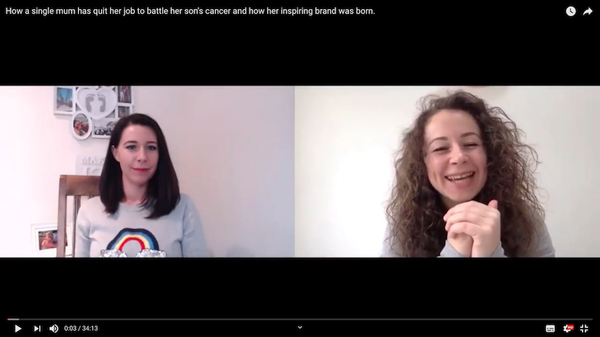
So as you consider your options around which path to take on your online business journey, we’d like to share another inspiring online business start up story with you, that of Holly Barras, from here in the UK.
After dealing with the death of one child, Holly, as a single working Mum, had to contend with the issues around supporting her remaining son who had been diagnosed with cancer.
In the short video below Holly shares how she managed to quit her job to battle her son’s cancer and how her inspiring brand was born and developed from this period of personal struggle:
What does it take to create a strong brand identity?
What challenges did she have to overcome?
What investment did she have to make to create her own business?
What is the most important thing while creating your own inspiring brand?
And, what are Holly’s vision and future plans?
Holly discusses these important questions in the inspiring interview below:
You know, you don’t have to hold a formal qualification to be able to educate another, in fact, my interaction with children and babes have given me many a great lesson that you can’t learn from a lecture theatre.
Specifically, it was the experience of holding abandoned dying babies that made me realise that for some people, life is just a day. Though newly born, they are fully human just like you, just like me, it’s just they never had the chance to grow old in this world like you or me. The lesson if you will, or question that remains with me from this experience is this:
If for some people, their lifetime is but a day, does that mean if I waste a day, I’m actually guilty of wasting a lifetime?
We all need to number our days, and apply ourselves to that which has lasting value, so why not create a business to add value to others based on our core values?
If you are interested creating a brand identity from your life lessons, if you’re interested in starting an online business based on your core values, if you’re interested in a no risk free trial of the very same educational and mentoring system that and Holly & I started out with with, then why not set up your own FREE TRIAL account by clicking here.
You’ll be able to explore the system at your own time and pace, have a FREE 1-2-1 with a system consultant over the phone at a time convenient to yourself, and if you feel it’s not for you, then you can cancel at any time without any additional cost to yourself.
Here’s to you being yourself, and here’s to your online success!