

Keep things so simple a 5 year old gets it!
On my journey to setting up an online business I came across Tim Low from Singapore. The thing that appealed to me about Tim was that replacing his six figure lawyers income through his online business didn’t make him go out and buy the latest fast car, but rather, gave him the time and financial freedom to volunteer in his local community, serving the Church as a Bereavement Counsellor, something that the time demands of the legal profession could not afford him.
As someone who has self-funded overseas missions and aid trips to vulnerable people groups, the business model that enabled Tim to make this transition really appealed to me.
What I also like about Tim is his honesty about his struggles. Tim like me admits that one of the most challenging things to deal with when transitioning from the corporate salary world, to the online entrepreneur world is the issue of ‘mindset’.
I know it sounds a bit ‘fluffy’, but when you’ve spent most of your life in corporate institutions, they do leave a mark on you and that can hold you back from stepping out into any new venture, including the the online world. That’s why having access to mentors on that journey, who are walking the trail with you, is such a valuable asset.
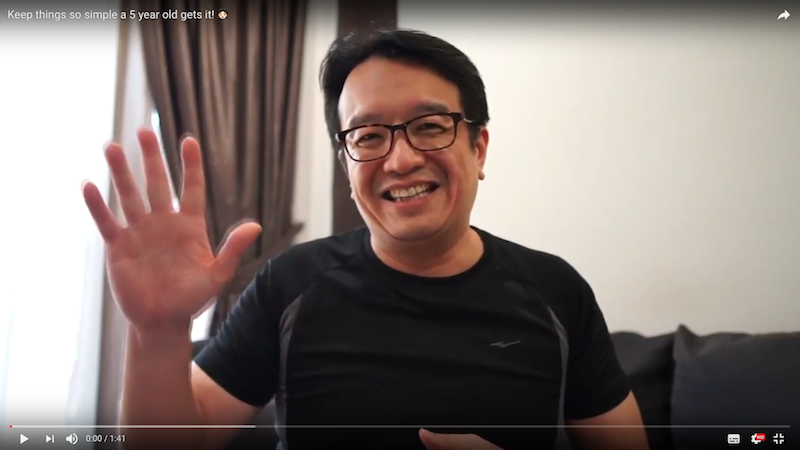
Anyway Tim shared this recent message which you can listen to in less than 2 minutes about keeping things simple as a means to success (click on image below to watch):
You see, many of us don’t get started at fulfilling our dreams, passions or business strategy because we over complicate things. But the truth is Tim & I only got started in online business by taking small simple steps with mentors on hand to advise us as we needed that guidance.
So if you’re interested in learning more about the exact same online business and education system that Tim & I used to start up our own businesses from scratch, then why not set up your own FREE TRIAL account by clicking here.
You’ll be able to explore the system for 30 days, have a FREE 1-2-1 with a system consultant over the phone at a time convenient to yourself, and if during those 30 days you feel it’s not for you, then you can cancel at any time without any additional cost to yourself.
Here’s to your online success!
Stephen

The Mind Body Connection
This week I wanted to share a thought with you about the Mind-Body Connection.
Did you know it’s only since the middle ages that the mind, body and spirit have been considered separate?
Before that, we were considered whole integrated people.
Writing as I am from the UK, it’s noticeable how our Western culture has been influenced by reductionism – splitting into parts and specialisation. Each aspect is now cared for separately: surgeons for the physical, psychiatrists for the mental and clergy for the spiritual.
Matters of health tend to be viewed by many as purely physical however, it’s not that simple. For example, the Reticular Activating System connects the cortex and the sub-brain; physical stimulation affects the mind and mental stressors affect the body, generating physical responses. In other words, our physical state of health affects our mental health and vice-versa.
Let us look for a moment at what we think, believe and meditate on and it’s relation to our physical state.
The belief of the mind has enormous influence over our physical abilities to the extent that sports psychology is the determining factor in many athletes physical performance.
Most people know the basic story of Roger Bannister, who, on May 6, 1954, broke the 4 minute mile with a time of 3 minutes 59 seconds. But what many people forget is that runners had been chasing the goal seriously since at least 1886 and that the challenge involved the most brilliant coaches and gifted athletes in North America, Europe, and Australia. For years runners had been striving against the clock, but the elusive four minutes had always beaten them to the extent that it had become as much a psychological barrier as a physical one.
When Bannister eventually broke the record, even his most ardent rivals breathed a sigh of relief. At last, somebody did it! And once they saw it could be done, they did it too. Only 46 days after Bannister’s feat, John Landy, an Australian runner, broke the barrier again, with an even faster time of 3 minutes 58 seconds! Then, just a year later, three runners broke the four-minute barrier in a single race. Over the last half century, more than a thousand runners have conquered a barrier that had once been considered hopelessly out of reach (the current record is 3 minutes 43 seconds).
Many studies have reviewed this phenomena of a sudden surge of success in the physical realm. They concluded that a positive mindset based on a belief of what could be possible is actually what helped those runners beat that record.
So does that mean we can all run a sub-4 minute mile if we simply believe it?
No. Because as whole integrated people there are other factors around health and fitness we also need to take into consideration. It does mean, however, that when it comes to success and wellbeing, in whatever sphere of life, what we think, believe and meditate on is key.
So, take control of those limiting thoughts that come your way; remember you have a purpose in this world that you can fulfil through a life of integrity.
If you have a dream in your heart, you don’t have to work out every detail of it before you take your first step. Instead, take one small step today and leave the other steps for tomorrow. Focus on what you can do now. Believe you will succeed and you will!
Here’s to fulfilling your dream!
Ruth

4 Steps Towards Resilience
One of my roles as a consultant over the years in what is now commonly called organisational resilience has been to come alongside Critical National Infrastructure businesses to identify threats/risks that an organisation may be vulnerable to, perform a gap analysis of organisational capacity and capability to deal with those threats/risks, then, identify opportunities for enhancement to enable a more resilient response.
I can share with you that regardless of the subject matter under review, the opportunities for enhancement identified came with the caveat that resilience is a journey not an end point. In other words, you can never be 100% resilient to all risks and threats, however, you can be more, or you can be less resilient than you are now. So, on the journey to resilience, I see my role as giving people a road map so that they can take the steps they need to becoming ‘more’ rather than ‘less’ resilient. It is however up to them whether they choose to take those steps or not.
So how does this apply to the small business owner, I mean, we can understand the large corporations taking organisational resilience seriously and going for ISO accreditation, but if you’re a sole trader already running or looking to start an online business, how does organisational resilience apply to you?
Well the first thing I would ask is, are you serious about starting/running an online business, or is it more like a hobby, something you’ll dip in and out of when you feel like it?
Only you can answer that question, but for those who are serious about running an online business, then all I can say is please do be serious about it, and do run it as you would any business, and that includes identifying threats and risks that you need to deal with.
The importance of your digital data
As an online business owner, think about how much you rely on your digital data, such as customer details, quotes, orders, and payment details. Now imagine how long you would be able to operate without that data?
You see, the truth is, all businesses, regardless of size, should take regular backups of their key data, and make sure that these backups are recent and can be restored. By doing this, you’re ensuring your business is more rather than less resilient, and can still function following an impact such as a flood, fire, physical damage, theft or other loss.
So to encourage you to be more rather than less resilient in your online business, here are 4 steps you can consider taking:
Step 1: Identify what data you need to back up
Your first step is to identify your essential data. That is, the information that your business couldn’t function without. Normally this will comprise documents, photos, emails, contacts, and calendars, most of which are kept in just a few common folders on your computer, phone, tablet or network.
Step 2: Keep your backup separate from your computer
Whether it’s on a USB stick, on a separate drive or a separate computer, access to data backups should be restricted so that they are not permanently connected (either physically or over a local network) to the device holding the original copy Ransomware (and other malware) can often move to attached storage automatically, which means any such backup could also be infected, leaving you with no backup to recover from. For more resilience, you should consider storing your backups in a different location, so fire or theft won’t result in you losing both copies. Cloud storage solutions are a cost-effective and efficient way of achieving this.
Step 3: Consider the cloud
You’ve probably already used cloud storage during your everyday work and personal life without even knowing – unless you’re running your own email server, your emails are already stored ‘in the cloud’.
Using cloud storage (where a service provider stores your data on their infrastructure) means your data is physically separate from your location. You’ll also benefit from a high level of availability. Service providers can supply your organisation with data storage and web services without you needing to invest in expensive hardware up front. Most providers offer a limited amount of storage space for free, and larger storage capacity for minimal costs to small businesses.
Step 4: Make backing up part of your everyday business
OK, so backing up is not a very interesting thing to do (and there will always be more important tasks that you feel should take priority), but the majority of network or cloud storage solutions now allow you to make backups automatically. For instance, when new files of a certain type are saved to specified folders. Using automated backups not only saves time, but also ensures that you have the latest version of your files should you need them.
Many off-the-shelf backup solutions are easy to set up, and are affordable considering the business-critical protection they offer. When choosing a solution, you’ll also have to consider how much data you need to back up, and how quickly you need to be able to access the data following any incident.
So do take those 4 small steps towards becoming more resilient online, and if this isn’t just a hobby for you, if you’re serious about getting professional mentoring for the whole lifecycle of online business principles by individuals who are themselves running successful online businesses, then why not set up your own FREE TRIAL account with the Six Figure Mentors by clicking here.
You’ll be able to explore the SFM system for 30 days, have a FREE 1-2-1 with a system consultant over the phone at a time convenient to yourself, and if during those 30 days you feel it’s not for you, then you can cancel at any time without any additional cost to yourself.
Here’s to your online resilience!
Stephen
